The unglamorous things that actually matter
Health advice has become incredibly complicated. Every week there seems to be another food you should avoid, supplement you apparently can’t live without, morning routine you should adopt, wearable you need to buy or “biohack” promising to make you healthier, younger and more energetic.
Some of it is interesting. Some of it may even be useful. But underneath all the noise, the things that have the biggest influence on our long-term health are remarkably unglamorous.
Move your body. Eat plenty of nutritious food. Sleep well. Manage stress. Don’t smoke. Be sensible with alcohol. Look after your relationships. Practise basic hygiene.
None of that is particularly exciting. You probably won’t see a social media influencer dramatically revealing the health benefits of going to bed on time. But these basics matter enormously.
First, something I've learned about health
The longer I work in fitness, and the more I learn about the human body, the more convinced I become of two things.
The first is that people are remarkably resilient. We adapt, learn, recover, help each other and often cope with far more than we thought we could. Some of the strongest influences on our health aren’t found in a gym or on a dinner plate either. Having people around us, feeling connected, having purpose and being part of a community matter too.
The second is much simpler: your health is incredibly valuable.
We tend to appreciate this most when something goes wrong. When your body is working reasonably well, it’s easy to take for granted the ability to get out of bed, walk up stairs, carry the shopping, play with your kids or grandkids, travel, work in the garden, play golf or simply get through a normal day without thinking about it.
Health isn’t just about avoiding disease or getting a better number on a medical test. It’s about capacity. It’s having a body and mind capable of participating in your life.
And while none of us can control every aspect of our health, there is an enormous amount we can influence through what we repeatedly do.
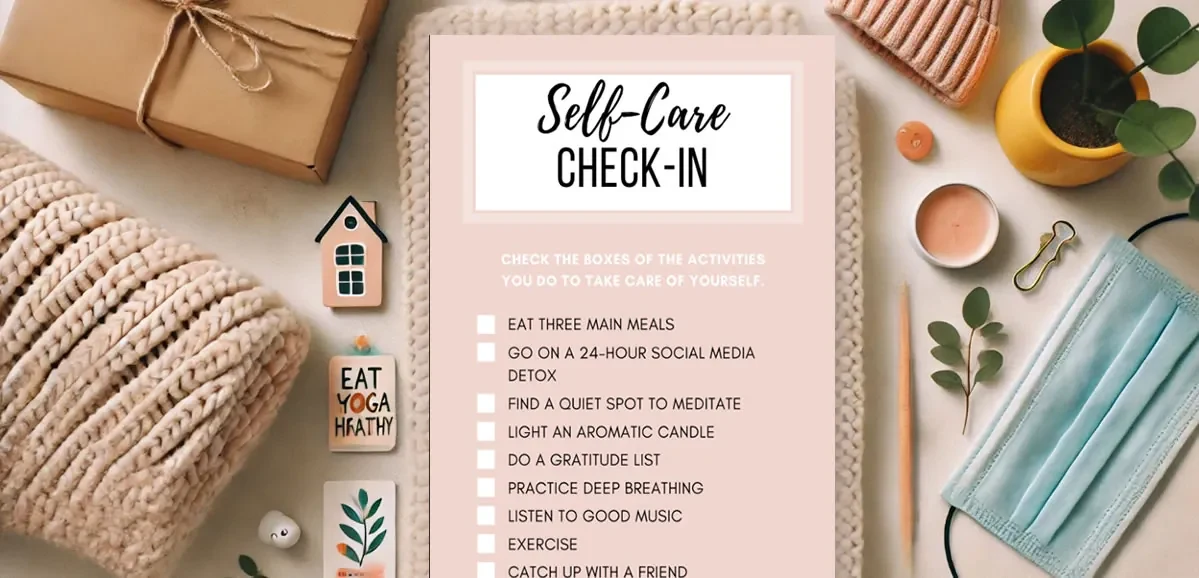
The self-care check-in
Don’t treat this like an exam where you need ten perfect answers. Think of it more like checking the dashboard in your car. If one light is flashing, it doesn’t mean the whole vehicle is falling apart. It simply tells you where some attention might be useful.
1. How are my stress levels, really?
Stress gets a bad reputation, but stress itself isn’t always the enemy. Your body is designed to respond to challenges. Exercise is a form of physical stress. Learning something difficult challenges the brain. Even stepping outside your comfort zone can produce a stress response. In appropriate doses, followed by recovery, that’s part of how we adapt.
The problem is chronic stress without enough recovery. If your brain constantly feels as though something needs your attention, your body doesn’t get many opportunities to switch off. Over time, prolonged stress can affect sleep, mood, concentration and health behaviours. It can also make the other things on this checklist harder.
When we’re exhausted and stressed, we’re less likely to exercise, more likely to reach for convenient food, more likely to drink too much, and far more likely to spend an hour scrolling through our phones instead of going to bed.
So ask yourself: have I actually had any downtime lately? Not scrolling. Not answering emails from the couch. Not watching television while simultaneously checking your phone. Actual downtime.
That might mean going for a walk, sitting outside with a coffee, listening to music, gardening, reading, doing some slow breathing or spending time with someone you enjoy.
You don’t necessarily need to eliminate stress. You need enough opportunities to recover from it.
2. What does most of my food actually look like?
Nutrition can become ridiculously complicated if you let it. Carbohydrates or no carbohydrates? Fasting or breakfast? Six small meals or three larger ones? Should you eat before training? After training? Is fruit too sugary? Which protein powder? What about seed oils?
Meanwhile, we can lose sight of a much simpler question: what does most of the food on my plate look like?
For most people, getting the foundations right matters far more than obsessing over nutritional details. That means regularly eating vegetables and fruit, getting enough protein, choosing mostly minimally processed foods, including sources of fibre and drinking enough fluids.
Australian dietary guidance recommends eating a variety of vegetables and fruit as part of a healthy dietary pattern. Rather than obsessing over antioxidants or one particular vitamin, variety is a useful goal because different plant foods provide different combinations of fibre, vitamins, minerals and other compounds.
An easy strategy is simply to eat more colours. Green vegetables. Red capsicum. Orange carrots. Blueberries. Tomatoes. Apples. Beans. Leafy greens.
3. Am I moving enough?
If there were a medicine that could improve cardiovascular health, physical function, strength, mood, sleep and long-term independence, we’d probably be pretty interested in it. Fortunately, we already have something that does all of those things: physical activity.
And importantly, exercise doesn’t only mean going to the gym. Walking counts. Gardening counts. Cycling counts. Swimming counts. Playing sport counts. Taking the stairs counts. A structured workout counts too.
Australian physical activity guidelines for adults encourage regular moderate-to-vigorous activity across the week along with muscle-strengthening activities on at least two days per week.
That strength component becomes increasingly important as we get older. Muscle isn’t just something bodybuilders care about. Strength helps you get out of chairs, climb stairs, carry things, maintain balance and continue doing everyday activities independently.
So rather than only asking “did I exercise today?”, I prefer three questions:
- Did I move?
- Did I challenge my cardiovascular system?
- Did I do something that helps maintain my strength?
You don’t need to tick all three boxes every day, but across the week you want a healthy mixture.
4. Am I sleeping enough to actually recover?
Sleep might be the least exciting performance-enhancing tool ever invented. It’s also one of the most important.
Adults generally need around seven to nine hours of sleep per night, although individual requirements vary. Sleep supports learning, memory, mood, immune function, physical recovery and a long list of other biological processes.
The trouble is that sleep is often treated as expendable. We’re busy, so we steal an hour from sleep. Then we’re tired, so we drink more coffee. Because we’re tired, training feels harder. Because we’re tired and hungry, food choices become harder. Then we finally get into bed and spend another 40 minutes looking at our phone.
It’s not difficult to see how one habit starts influencing another.
If your sleep isn’t great, start with the boring things before buying gadgets and supplements. Try to keep your sleeping and waking times reasonably consistent. Make the bedroom comfortable, dark and quiet. Be sensible with caffeine later in the day. Give yourself some time to wind down rather than expecting your brain to go directly from emails and social media to deep sleep.
5. Am I looking after basic hygiene?
Not every useful health habit needs an entire wellness philosophy attached to it. Sometimes soap and water are pretty impressive.
Regular handwashing remains a simple way to reduce the spread of many infections, particularly before preparing or eating food, after using the toilet, after coughing or sneezing into your hands and when they’re visibly dirty. It’s one of those health behaviours that becomes almost automatic, which is exactly what we want.
The same principle applies to basic dental care, food hygiene, sun protection and staying home when you’re genuinely unwell and contagious.
Self-care doesn’t always look like yoga at sunrise. Sometimes it looks like washing your hands and brushing your teeth.
6. What’s my relationship with alcohol?
Alcohol is an interesting one because it can easily become part of a routine without us paying much attention to it. A glass after work. A couple on Friday. Dinner with friends. A few more over the weekend.
None of those moments necessarily feels significant by itself, which is why it’s worth occasionally stepping back and looking at the pattern.
Alcohol can affect sleep quality, recovery, appetite, judgement and training performance, and higher levels of consumption increase the risk of numerous health problems.
You don’t necessarily need to make alcohol a moral issue. Just make it an honest one. How much are you actually drinking? How often? How do you sleep afterwards? How does it affect tomorrow’s workout? Could you comfortably go without it?
Those questions are often more useful than simply labelling drinking as “good” or “bad.”
7. If you smoke, quitting may be the biggest health win available
There isn’t much ambiguity around this one. Smoking damages virtually every organ system and substantially increases the risk of cardiovascular disease, respiratory disease, cancer and premature death.
If you don’t smoke, don’t start. If you do smoke, quitting can produce meaningful health benefits regardless of how long you’ve smoked.
And if you’ve tried to quit before and started again, that doesn’t mean you can’t do it. Behaviour change is rarely a perfectly straight line. Support from your GP, pharmacist or an evidence-based quitting service can make the process considerably easier.
This is one area where asking for help isn’t weakness. It’s strategy.
8. Am I spending time with people who are good for me?
This wasn’t prominent enough in my original checklist, and I think it deserves to be.
Health isn’t purely biological. We’re social creatures. Relationships, community and social connection can influence both mental and physical wellbeing. Spending time with people we care about can provide support, laughter, perspective and a sense of belonging.
And no, sending someone a thumbs-up emoji isn’t always quite the same.
Call someone. Have coffee. Go for a walk together. Train with somebody. Have dinner without everybody staring at their phones.
Sometimes the healthiest thing you can do on a Sunday afternoon isn’t another workout. It’s spending two hours laughing with someone you love.
9. Am I getting outside?
This one is beautifully simple. Go outside.
Walking outdoors gives you physical activity, a change of environment and an opportunity to get away from screens. Daylight exposure, particularly earlier in the day, also helps regulate your body’s circadian rhythm.
You don’t need to turn it into an expedition. Walk around the block. Sit in the garden. Take your coffee outside. Walk the dog. Go to the beach. Meet someone for a walk instead of sitting in a café.
We spend an extraordinary amount of our lives staring at artificial light through rectangular screens. Every now and then, give your eyes something further away than 40 centimetres.
10. Am I doing things I actually enjoy?
This may be the most overlooked part of self-care. Health shouldn’t become a second job.
If your entire week consists of work, responsibilities, meal preparation, exercise because you’re “supposed to”, and trying to get enough sleep so you can repeat everything tomorrow, something is missing.
What do you do purely because you enjoy it? Golf? Gardening? Fishing? Music? Cooking? Travel? Painting? Walking the dog? Playing with the grandkids? Going out for breakfast?
You don't need to fix everything at once
After reading a checklist like this, there’s a temptation to identify six things you’re doing badly and decide that tomorrow morning you’re changing all of them.
Don’t.
We’ve talked before about how habits actually form, and enormous lifestyle overhauls tend to look much better on paper than they do in real life.
Pick the area that would make the biggest difference right now.
Maybe your exercise is going well but your sleep has slowly deteriorated. Work on sleep. Maybe you’re sleeping well but you’ve barely moved for the past three months. Start walking. Maybe you exercise regularly but realise stress has taken over your evenings. Create some genuine downtime. Maybe everything looks pretty good except you’ve gradually become socially isolated. Call someone.
One useful change that lasts is worth far more than ten perfect intentions that disappear by next Monday.
Pick the one flashing light on the dashboard. The rest will still be there next month.
Your five-minute health check
Every few months, come back to these questions.
- Stress: Am I recovering as well as I’m coping?
- Food: Does most of what I eat support my health?
- Movement: Am I active and maintaining my strength?
- Sleep: Am I giving my body enough opportunity to recover?
- Hygiene: Am I keeping up with the simple preventative basics?
- Alcohol and smoking: Are my choices helping or harming my health?
- Connection: Am I spending enough time with people who matter to me?
- Outside: Am I regularly getting daylight, fresh air and movement?
- Enjoyment: Am I actually using my health to enjoy my life?
You don’t need a perfect score. Nobody gets one. You’re simply looking for the area that needs a little more attention.
The basics are boring — that's why we keep looking for something else
There’s always going to be a new health trend. A new supplement. A new diet. A new wearable. A new “secret” to longevity.
Some of those things may eventually prove useful, but none of them makes the fundamentals disappear.
Your body still needs movement. Your muscles still need resistance. Your brain still needs sleep. Your diet still needs nutritious food. You still need recovery. You still need other people. And you still need reasons to get out of bed and use the body you’re trying so hard to look after.
The goal isn’t to create a perfectly optimised life. It’s to build a body and mind that allow you to keep saying yes to the life you want to live.
That’s a health plan worth sticking with.
- self-care
- wellbeing
- habits