
We may have been asking the wrong question
There’s an idea about habits that has been floating around for decades. Do something for 21 days and it becomes a habit.
It sounds wonderfully simple: drink more water for three weeks, exercise every morning for three weeks, stop eating biscuits after dinner for three weeks. Reach day 22 and, apparently, your brain stamps HABIT APPROVED on the paperwork and you never have to think about it again.
If only it worked like that.
Anyone who has enthusiastically started a new routine in January and quietly misplaced it somewhere around February knows that human behaviour doesn’t operate on neat timelines. Real life is far less tidy, and researchers who study habits have spent years trying to understand what is actually going on. The answer is both messier and far more interesting than a magic number of days.
Where did the 21-day habit idea come from anyway?
The famous “21 days to form a habit” idea wasn’t originally based on habit research at all. It is commonly traced back to plastic surgeon Maxwell Maltz, who in the 1950s and 1960s noticed that his patients often seemed to take around three weeks to adjust psychologically to changes in their appearance. He also observed similar adjustment patterns in his own behaviour.
Maltz wrote about these observations in his 1960 book Psycho-Cybernetics, noting that change often seemed to require at least around 21 days. Over time, that careful observation was simplified into something far more appealing: it takes 21 days to create a habit.
It’s a great line for a motivational poster, but it isn’t a particularly accurate description of how human behaviour works.
Modern habit research shows enormous variation between people and between behaviours. One well-known study that tracked everyday habits such as drinking water, eating fruit, or exercising found that, on average, behaviours took around 66 days to become automatic. But even that number hides a huge spread.
Some people formed habits in a few weeks. Others took several months. And that makes perfect sense when you think about the behaviours involved. Drinking a glass of water with breakfast is simple and low effort. Going to the gym four mornings a week is a completely different challenge involving time, planning, motivation, travel, and recovery. Why would we expect those two behaviours to take the same amount of time to become automatic?
Your brain doesn't have a 66-day countdown timer
This is where habit advice often goes wrong again. We replace one magic number with another and carry on counting. Day 17. Day 34. Day 52. Nearly there…
But your brain isn’t sitting inside your skull with a calendar waiting for day 66 to arrive. What’s actually happening is far more interesting.
Every time you repeat a behaviour in a similar context, you are giving your nervous system another opportunity to learn the relationship between cue → behaviour → outcome.
You finish dinner, you put your walking shoes on, and you go for a walk. The first time, it’s just something you did. But repeat that pattern often enough and your brain begins to recognise it: “Ah, dinner is finished. This is when we walk.”
Over time, the context itself starts to trigger the behaviour, and what once required a conscious decision begins to feel more automatic.
Think reps, not days
This is why it’s more useful to think about habits in terms of repetitions rather than time.
Imagine two people starting strength training. Sarah trains every Monday, Wednesday, and Friday. John trains whenever he gets a chance.
After four weeks, Sarah has completed 12 sessions. John has completed four. On paper, they’ve both been “doing it for a month,” but their brains have had very different learning experiences.
Sarah has had twelve full cycles of getting ready, travelling, training, and recovering. John has had four. The calendar says the same thing, but the behaviour tells a completely different story.
This is why consistency matters so much. You are not just exercising or eating differently; you are practising the identity of someone who does those things.
Your brain is constantly changing
This brings us to one of the most important ideas in neuroscience: neuroplasticity.
For a long time, the adult brain was thought to be relatively fixed. We now know that isn’t true. The brain remains capable of change throughout life. Neural connections strengthen and weaken, networks reorganise, and structure can adapt in response to learning, experience, and behaviour.
In other words, what you repeatedly do matters — quite literally.
What taxi drivers taught us about the brain
Before GPS, London taxi drivers had to learn an extraordinary amount of geographic detail known as “The Knowledge.” This involved memorising thousands of streets, routes, and landmarks across one of the most complex cities in the world.
Research comparing these drivers to non-drivers found differences in the hippocampus, a brain region involved in memory and spatial navigation. Even more interestingly, studies of trainee taxi drivers showed that as they learned The Knowledge, structural changes in the brain appeared to develop alongside that learning.
The takeaway is not that memorising streets is the same as building habits, but that the adult brain is not fixed. It adapts in response to repeated demands placed upon it.
Learning matters. Practice matters. Repetition matters.
And the same principle applies, in a simpler form, to everyday behaviours like exercise, eating, or sleep routines: your nervous system adapts to what you repeatedly ask it to do.
Your brain and your muscles have something in common
If you go to the gym once and do three sets of squats, you don’t expect your legs to transform overnight. But if you repeat that stimulus consistently over weeks and months, your body adapts. Muscles grow stronger, movement becomes more efficient, and your nervous system becomes better at coordinating the effort.
You don’t stand in front of the mirror after every session asking whether adaptation has happened yet. You understand that change is the result of repeated exposure over time.
Habits work in a very similar way. Instead of obsessing over when a behaviour officially becomes a habit, it is far more useful to simply focus on getting the next repetition done.
But repetition alone isn't the whole story
Of course, repetition by itself isn’t enough. If it were, any random behaviour performed often enough would become automatic, which clearly isn’t the case. Context plays a huge role in habit formation.
Compare these two approaches to drinking more water: “I’ll try to drink more water,” versus “After I make my morning coffee, I’ll drink a glass of water.”
The second version works better because it attaches the behaviour to a consistent cue. Coffee becomes the trigger for water, and over time the sequence strengthens: coffee → water. Coffee → water. Coffee → water.
This is the same principle behind BJ Fogg’s Tiny Habits approach: make the behaviour small, attach it to something that already happens, and repeat it in a consistent context.
The REACH idea: a useful way to think about brain change
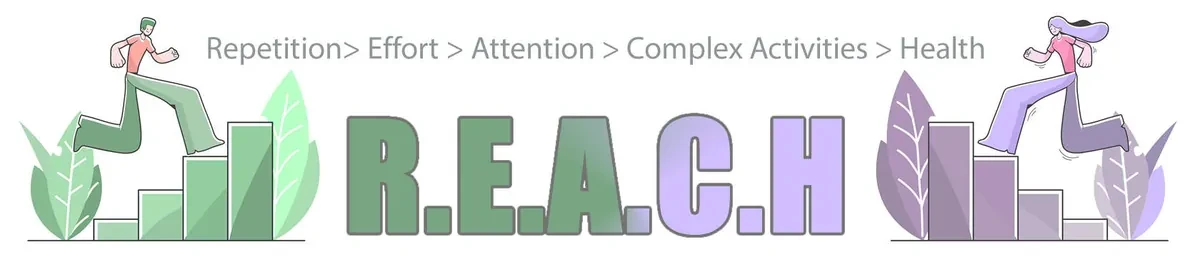
You may also come across the acronym REACH in discussions of neuroplasticity. It isn’t a strict scientific law, but it is a helpful way of thinking about the conditions that support learning.
R: Repetition
Your brain needs repeated opportunities to practise. Thinking about the behaviour is not enough; doing it is what matters.
E: Effort
Some level of challenge is required for adaptation, but not so much that the behaviour becomes aversive. The goal is enough effort to stimulate change, not so much that you avoid repeating it.
A: Attention
What you focus on matters. Paying attention to what you are doing improves learning, especially when acquiring new skills or behaviours.
C: Challenge and complexity
More complex behaviours take longer to learn because they involve more moving parts. We shouldn’t expect drinking water and learning a new language to follow the same timeline.
H: Health
Sleep, nutrition, stress, and physical activity all influence how well your brain learns and adapts. Exercise is particularly powerful because it directly supports brain function and plasticity.
Why missing one day doesn't destroy your habit
One of the most important things to understand is that missing a day does not undo progress. In most habit research, a single missed opportunity does not significantly derail the overall process.
The problem is that people often turn one missed day into a story of failure. You miss Monday’s workout, then think you’ve “broken the streak,” so you miss Tuesday, then Wednesday, and suddenly the habit is gone.
But that’s not how learning works.
One missed repetition is just one missed repetition.
The next opportunity is still there.
Make your reps easy to collect
If you want more repetitions, the key is to make the behaviour easier to repeat. Instead of aiming for dramatic change, focus on small, repeatable actions tied to clear cues.
- Rather than “I’ll exercise for an hour every day,” try “After dinner, I’ll walk for ten minutes.”
- Instead of “I’m changing my entire diet,” try “I’ll add vegetables to my evening meal.”
- Instead of “I’ll become flexible,” try “After brushing my teeth, I’ll do one minute of mobility.”
The goal is not perfection. The goal is repetition.
Stop asking, “How long until this becomes a habit?”
A more useful question is: how many good reps did I get this week?
Three planned walks completed? That’s three reps. Four healthy meals out of five? That’s four reps. Two gym sessions? That’s two reps.
Now you have something concrete to work with.
You are practising your future normal
Each individual repetition might feel small, but together they are shaping what your life looks like. One walk won’t transform your fitness, and one healthy meal won’t change your diet, but repeated consistently, these actions begin to define your normal.
Over time, something shifts. You stop debating whether to go for a walk after dinner. You just do it. Not because you reached day 21, but because the behaviour has become part of how you live.
So, how long does it take to create a habit?
There is no single answer. Some behaviours become automatic quickly, others take months, and some take longer still. The variation is normal because the behaviours themselves are different, and so are the people performing them.
Perhaps the real lesson is that time was never the most useful thing to measure in the first place.
Your brain is adaptable, but it needs repetition to work with. So instead of asking how long it takes, ask: what rep can you get in today?
- habits
- mindset
- back on track