

Golf
Why the Gym Is the Only Club You're Missing
Better mobility. More strength. Smarter movement. The real difference behind your best rounds.
Overcoming the Golf Fitness Plateau
We’ve all been there: you buy the $600 carbon-faced driver, book a series of lessons to refine your plane, and spend every Saturday grinding on the range.
But what if the thing holding your golf game back isn’t your clubs or even your swing?
What if it’s your body?
Golf isn’t just a game of positions. A full golf swing is a fast, explosive athletic movement. If your upper back doesn’t rotate well, your hips are stiff or you struggle to control your trunk, your body has to find that movement somewhere else.
That “stiffness” isn’t just an inconvenience — it’s effectively shortening your backswing and robbing you of the speed you’re paying for.
The uncomfortable reality is that many golfers are chasing a “perfect swing” that is a physical impossibility for their current body to execute. That’s where the gym starts becoming useful.
You can't swing around a body that won't move
For years, the industry has preached a “perfect” kinematic sequence: the idea that the hips, torso, lead arm and club must accelerate and decelerate in a precise, rigid order. However, research by Cheetham and Broker (2016) revealed a jarring truth — only 25% of 95 PGA Tour players and 39% of 31 LPGA Tour players actually utilised this “ideal” sequence.
If the majority of the world’s best aren’t “perfect”, how are they so dominant? They compensate for technical deviations with a high-functioning physical engine. Specifically, they rely on motor control and stability, which are crucial for enhancing your golf fitness and reducing injury risk. These athletes possess the neurological ability to coordinate complex movements and the stability to maintain their centre of mass under extreme force. If you want to play like a pro, you don’t necessarily need a “perfect” sequence; you need the physical capacity.
This is exactly what the gym program we created at the bottom of this page does. It helps create motor control and stability.

Source: Cheetham & Broker (2016), 95 PGA and 31 LPGA Tour players
You have about a quarter of a second
Here’s where golf gets interesting.
Muscle force doesn’t appear instantly. In other words, the golf swing doesn’t politely wait for you to get strong. You have to produce force, and produce it quickly.
This helps explain why golfers benefit from developing more than just traditional strength. Rate of force development, power and the ability to coordinate different parts of the body all matter.
It also helps explain the importance of separation between the pelvis and upper body. During the transition from backswing to downswing, the lower body can begin moving while the upper body is still completing its turn. That creates separation and helps the golfer use the stretch-shortening cycle to generate force rapidly.
And we can actually measure some of this. Golf performance research led by Jack Wells found that countermovement-jump peak impulse was significantly associated with clubhead velocity.
Translation: what you can do in the gym can tell us something about what you’re capable of doing with a golf club.

Source: Research cited by the Titleist Performance Institute
Strength is your insurance policy
There’s another myth I’d happily send into the water hazard.
A bigger strength reserve makes every swing cheaper.
If your swing requires 90% of everything your body can produce, every repetition is expensive. If it represents 60%, you have room to spare.
That’s your strength reserve — and it becomes increasingly important as we get older. Ageing is associated with losses in muscle mass, strength and particularly power if we don’t train to maintain them. For a golfer, those changes eventually show up where it hurts most: the number next to your driver distance.
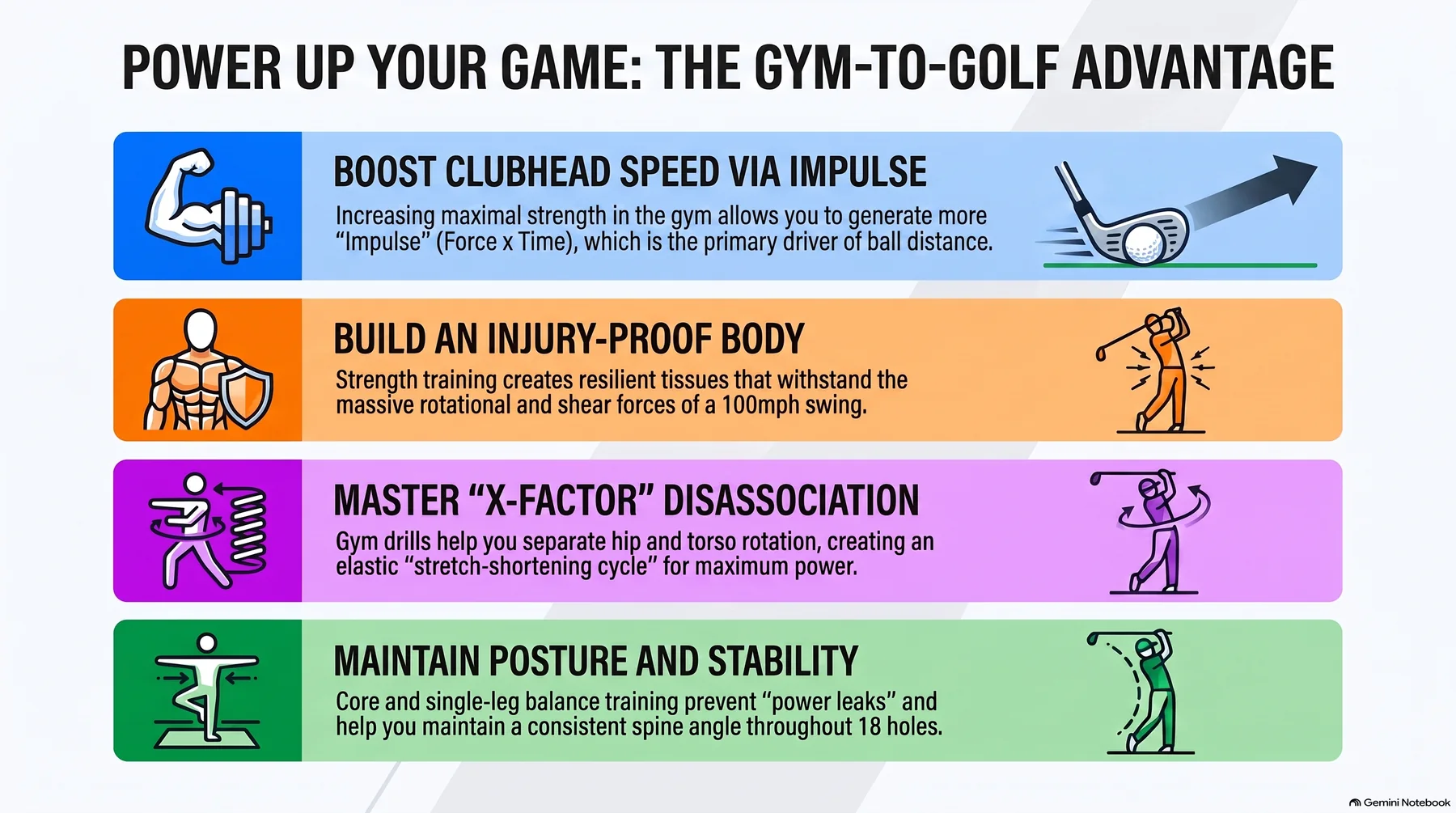
The goal isn’t to turn golfers into bodybuilders. It’s to give them a bigger engine.
Squats, hinges, pushes, pulls, carries, rotational exercises and appropriately programmed power work can all contribute to a body that is better prepared for the demands of golf.
- golf
- strength
- mobility