Stressed about things you can do nothing about
You open your phone and see another worrying news story. Someone says something online that annoys you. The cost of living goes up. The weather ruins your weekend plans. Someone else’s behaviour frustrates you, work becomes unpredictable, or you start worrying about something that might happen six months from now.
Before you know it, you’ve spent half the morning mentally wrestling with situations you have very little power to change.
Meanwhile, the things you do have some control over — how you spend your morning, whether you exercise, what you eat, how you respond to people and where you direct your attention — barely get a look in.
It’s a strange habit we humans have, and it’s also an exhausting one.
Two circles that can change how you look at stress
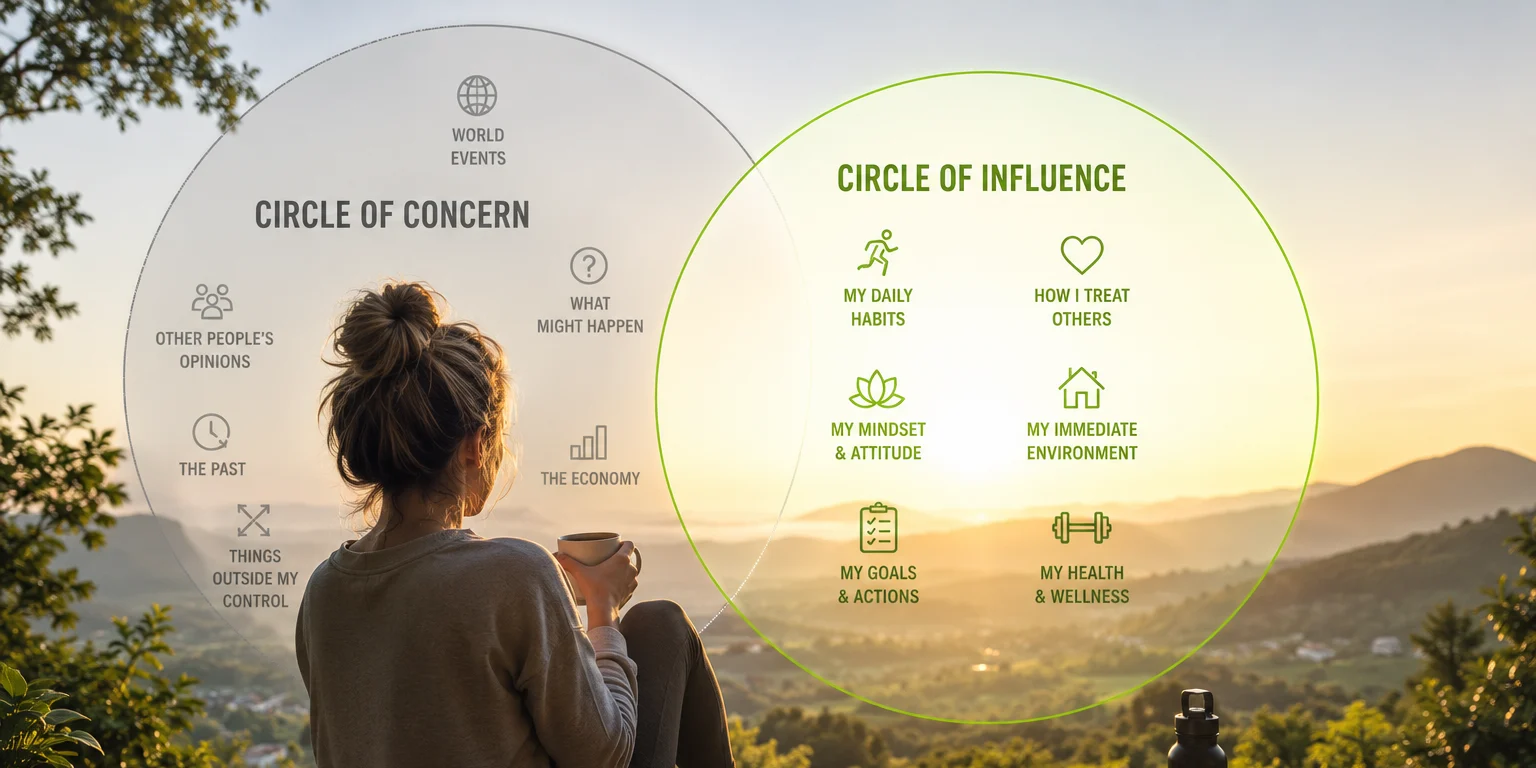
The idea is most commonly associated with Stephen R. Covey’s The 7 Habits of Highly Effective People. Covey described two circles: the Circle of Concern and the Circle of Influence.
Your Circle of Concern contains all the things you care or worry about but cannot directly control. That might include world events, the economy, other people’s opinions, decisions made by governments or organisations, things that happened in the past and uncertainty about what might happen in the future.
These things can certainly affect your life, so the idea isn’t to pretend they don’t matter. The problem starts when they consume most of your attention despite giving you very few useful actions to take.
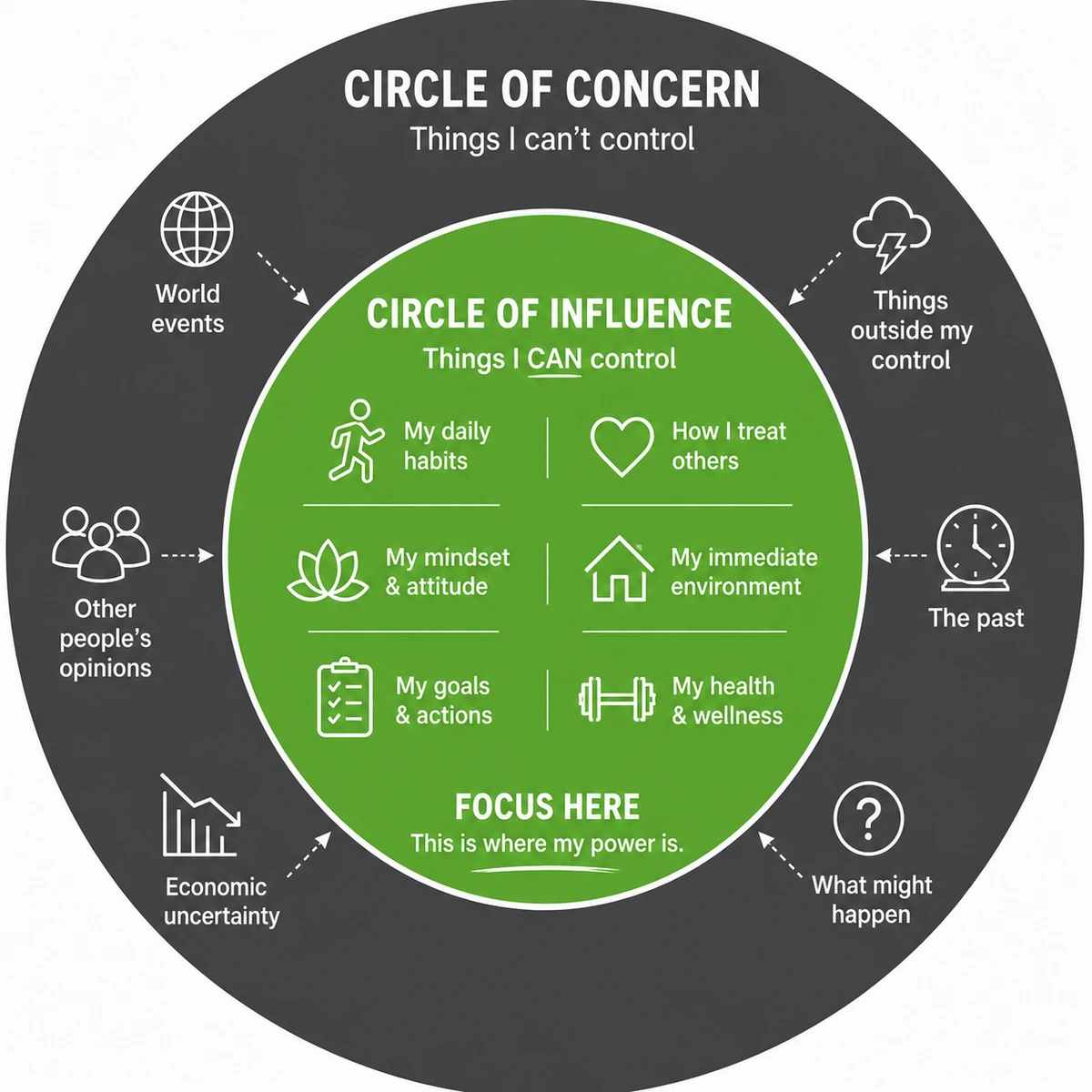
Inside that larger circle sits your Circle of Influence. This contains the things where your choices and actions can make a genuine difference: your daily habits, your behaviour, how you treat people, your training, your sleep routine, the food you choose, how you organise your environment and how you respond when life doesn’t go according to plan.
The distinction sounds simple, but it can completely change the way you respond to a stressful situation.
Concern asks 'What if?' Influence asks 'What now?'
Imagine you’ve just read a worrying story about the economy. Your mind can quickly disappear down the rabbit hole.
What if things get worse? What if prices keep rising? What if interest rates change? What if this happens? What if that happens?
Some awareness of what’s happening is obviously sensible, particularly if it affects decisions you need to make. But there eventually comes a point where you’re no longer gathering useful information. You’re simply rehearsing uncertainty.
That’s life inside the Circle of Concern. Now change the question. Instead of asking “What if?”, ask: “What can I actually do about this today?”
Perhaps there is a practical financial decision you can make. Perhaps you need to have a conversation, change something in your budget or seek professional advice. If there genuinely is something you can do, you’ve just moved the problem into your Circle of Influence.
But sometimes the answer will simply be: “Nothing right now.”
And that’s useful information too. It means you can stop giving the problem your attention for the moment and put that energy somewhere it can actually accomplish something.
Why uncertainty can feel so exhausting
Our brains aren’t particularly fond of uncertainty. When something feels threatening but the outcome is unclear, we naturally try to gather information and predict what might happen next.
That’s useful when the information helps us make a decision. It’s less useful when there is no decision to make.
This is one reason endlessly checking news feeds and social media can leave you feeling strangely exhausted despite having done very little physically. Your brain keeps receiving new information, evaluating possible threats, forming opinions and deciding whether something requires your attention. Then you refresh the screen and start again.
You can easily spend an hour consuming information without completing a single action that improves the situation.
Being informed is valuable. Being permanently immersed isn’t the same thing.
Control what you can, influence what you can, release the rest
There is an important distinction worth making here. Very few things in life are completely under our control.
You can’t completely control your health, for example. Genetics, illness, injuries and plain bad luck exist. What you can influence are many of the behaviours that support your health, including physical activity, nutrition, sleep, preventive healthcare and how you manage stress.
You can’t control how another person behaves, but you can influence how you communicate with them and choose how you respond.
You can’t control whether your carefully planned outdoor walk gets ruined by rain, but you can decide whether that means no exercise today or whether you do something else instead.
Your body can help get your brain out of the loop
When you’re stressed, one of the simplest things you can do is change what you’re doing physically.
If you’ve been sitting on the couch scrolling through your phone and becoming increasingly agitated, staying there for another 45 minutes probably isn’t going to improve things.
Get up. Go outside and walk. Train. Put some music on and do something around the house. Spend ten minutes gardening. Take the dog out.
The goal isn’t to pretend the stressful situation doesn’t exist. You’re interrupting a loop and redirecting your attention towards something constructive.
Exercise can be particularly useful here. Regular physical activity is associated with better mental health and can help reduce symptoms of stress and anxiety. It also gives you something extremely valuable when the rest of life feels uncertain: an action you can take right now.
You may not be able to solve the world’s problems this afternoon, but you can probably go for a 20-minute walk. That’s inside your circle.
Give your brain some quiet
There is another habit that has become increasingly difficult in modern life. Doing nothing.
Think about the last time you sat quietly for five minutes without television, music, a podcast, email, social media or your phone in your hand. For many of us, almost every empty moment gets filled with information.
Waiting for coffee? Phone. Sitting in the car before an appointment? Phone. Television ad? Phone. Standing in a queue? Phone.
Our brains rarely get a moment when nobody is trying to tell us something.
Creating a few minutes of deliberate quiet can help break that pattern. You might meditate, practise slow breathing, sit outside with your coffee or simply stare out the window for a while.
It doesn’t need to become another complicated wellness routine that requires an app, subscription and special cushion. Five quiet minutes is a perfectly respectable place to start.
Be informed without living inside the news
News and social media deserve their own place in this conversation because they provide almost unlimited access to your Circle of Concern.
There will always be another crisis. Another argument. Another prediction. Another outrage. Another person explaining why you should be terrified about something.
The problem isn’t necessarily the information itself. It’s the volume and frequency with which we consume it.
Try putting some boundaries around it. Check the news once or twice rather than repeatedly throughout the day. Choose reliable sources instead of endlessly scrolling headlines. Turn off notifications that don’t genuinely require your immediate attention.
Learn what you need to know, decide whether there is an action you need to take, and then move on with your day.
Your morning matters more than you might think
One of the easiest places to practise your Circle of Influence is the first part of your day.
Imagine waking up, reaching for your phone and immediately reading emails, headlines, messages and social media. Before you’ve even put your feet on the floor, other people have decided what your brain is thinking about.
Compare that with giving yourself the first 15 or 20 minutes. Drink some water. Make coffee. Walk outside. Stretch. Have breakfast. Write down what you need to do. Sit quietly for a few minutes.
It doesn’t have to be an elaborate “5am billionaire morning routine.” It just needs to belong to you.
Starting the day with a few intentional actions is a simple way of beginning inside your Circle of Influence rather than immediately jumping into everyone else’s Circle of Concern.
Don't underestimate gratitude
Gratitude can sometimes sound a little fluffy, but the underlying idea is practical.
Stress directs attention towards problems, threats and things that are missing. Deliberately noticing something that’s going well provides a counterbalance.
You don’t need a beautifully bound gratitude journal. Ask yourself: “What was good today?”
Maybe you trained. Maybe you had dinner with someone you love. Maybe your back felt better. Maybe the weather was beautiful. Maybe somebody made you laugh. Maybe nothing spectacular happened, and you simply had a decent day.
The point isn’t to pretend problems don’t exist. It’s to stop problems becoming the only things your brain notices.
Look after the basics when life gets messy
One of the great ironies of stressful periods is that the behaviours that can help us cope are often the first things we abandon.
We’re busy, so we stop exercising. We’re tired, so we stay up late watching television. We’re stressed, so we eat whatever is convenient. We’re overwhelmed, so we cancel the walk or gym session that might actually have helped.
Then we wonder why everything feels harder.
This is when the basics matter most. Keep moving regularly. Eat reasonably well most of the time. Protect your sleep where you can. Spend time with people who leave you feeling better rather than worse. Get outside. Give your brain periods without constant stimulation.
None of these things makes you immune to stress. They simply give you a better foundation for dealing with it.
A practical Circle of Influence reset
The next time you notice yourself becoming stressed, frustrated or overwhelmed, grab a piece of paper and draw two circles.
In the outside circle, write down everything that’s currently occupying your mind that you cannot directly change — other people’s opinions, something that happened yesterday, a decision someone else has to make, the economy, a news story, what might happen next month.
Then look at each concern and ask: “Is there anything useful I can actually do about this?”
If the answer is yes, move that action into the inner circle. Make the phone call. Book the appointment. Go for the walk. Have the conversation. Prepare the meal. Turn off the news. Go to bed earlier. Ask for help. Do the workout.
If there isn’t an action available to you right now, acknowledge that too.
You don't need to solve every problem simply because your brain is capable of worrying about it.
Sometimes the honest answer is “nothing right now” — and that frees the energy up for something that does have somewhere to go.
Spend more time where your actions matter
The Circle of Influence isn’t about ignoring reality, avoiding difficult conversations or pretending everything is wonderful. It’s about recognising that your energy is limited.
You can spend that energy worrying about everything happening around you, including hundreds of things you cannot control, or you can deliberately invest more of it in the handful of things where your actions can genuinely make a difference.
Your habits. Your health. Your relationships. Your environment. Your behaviour. Your response. Your next decision.
You won’t always get it right. Nobody lives permanently inside their Circle of Influence. We all worry about things we can’t control from time to time.
But when you catch yourself drifting outward, you can come back to one simple question: “What can I influence right now?”
Sometimes the answer will be something important. Sometimes it’ll simply be putting the phone down, putting your shoes on and going for a walk.
Either way, you’ve moved from worrying about life to participating in it. And that’s a much better place to be.
- mindset
- wellbeing
- stress