

Exercise
Exercise and Diabetes: How Movement Helps You Take Control
Every time your muscles work, you change the way your body handles glucose. What exercise actually does, how much you need, and how to do it safely — with type 1 and type 2 treated as the different problems they are.
More Than Burning Calories
If you have diabetes, exercise is about far more than burning calories or getting fitter.
Every time you walk, cycle, lift a weight or get your muscles working, you change the way your body handles glucose. In fact, physical activity is one of the most powerful non-pharmacological tools we have for managing diabetes.
But there is an important catch.
For someone with type 2 diabetes, exercise can help muscles pull glucose out of the bloodstream and improve insulin sensitivity. For someone with type 1 diabetes, those same benefits exist, but exercise also introduces another challenge: balancing insulin, food and activity so blood glucose doesn’t fall too low or climb too high.
So rather than simply saying, “Exercise is good for diabetes,” let’s look at what exercise actually does, how much you need, and how to do it safely.
Type 1 and type 2 are not the same problem
Both conditions result in elevated blood glucose, known as hyperglycemia, but they get there in very different ways.
Two different routes to the same problem
An autoimmune condition
Type 1 diabetes (T1D) is an autoimmune condition. The immune system attacks and destroys the insulin-producing beta cells in the pancreas.
As a result, people with type 1 diabetes produce little to no insulin and require lifelong insulin therapy.
Exercise can be extremely beneficial, but it creates a balancing act. You need enough insulin to manage glucose, enough carbohydrate to fuel activity, and not so much insulin circulating that your blood glucose drops too far during or after exercise.
This is why exercise with T1D often involves actively adjusting insulin doses, carbohydrate intake or both.
The tissues stop responding
Type 2 diabetes (T2D) works differently.
The body still produces insulin, particularly in the earlier stages, but the tissues become less responsive to it. Over time, insulin production may also become insufficient.
This is where exercise becomes particularly interesting. When your muscles contract, they can increase glucose uptake from the bloodstream through pathways that do not rely entirely on insulin.
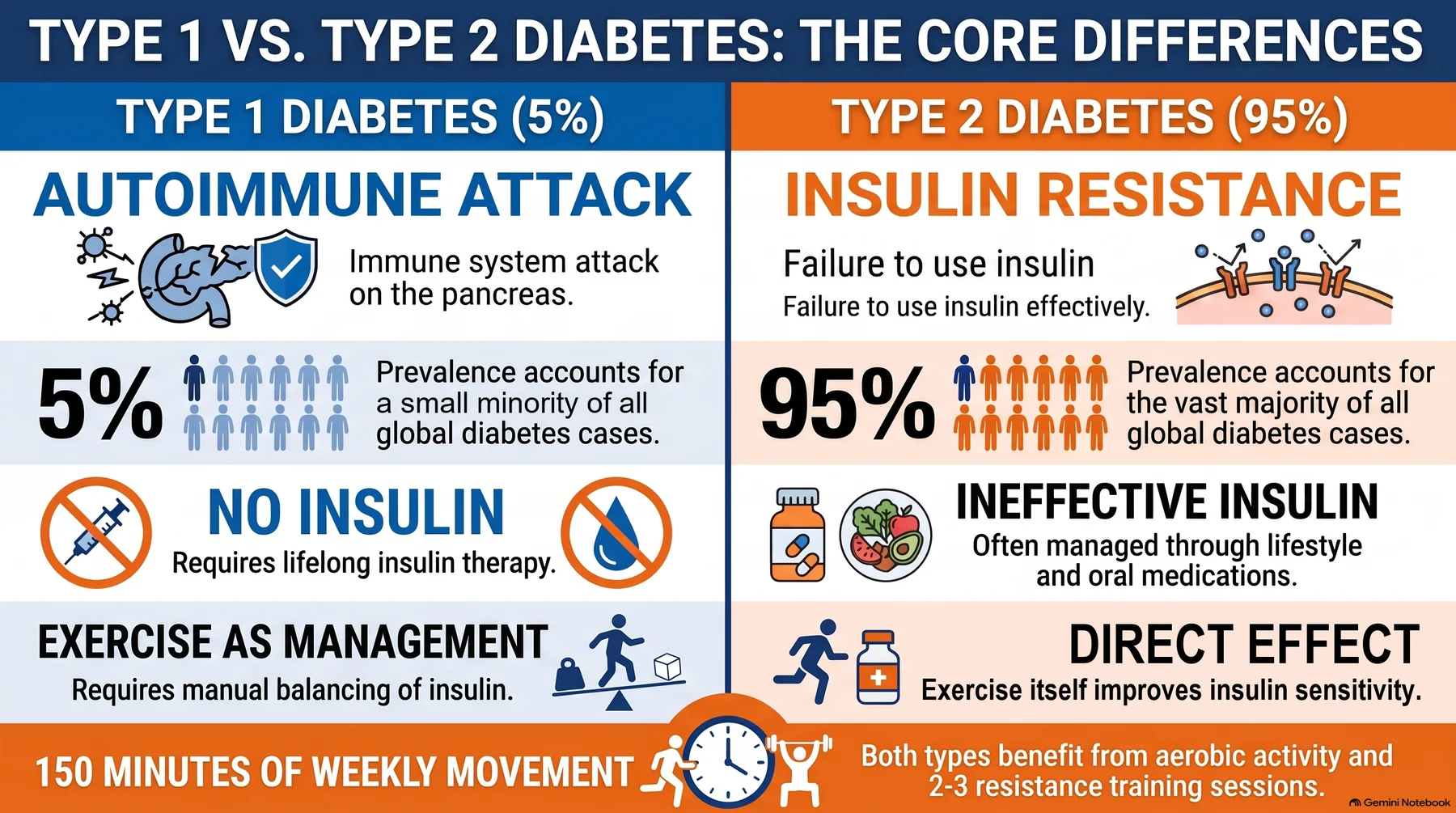
That is one of the reasons movement can be such an effective part of managing type 2 diabetes.
Why exercise is so powerful here
The benefits go well beyond what happens to your blood glucose during a workout.
With type 1 diabetes, regular exercise can:
Improve cardiovascular fitness · increase insulin sensitivity · potentially reduce baseline insulin requirements · improve cholesterol and lipid profiles · help regulate blood pressure
Strengthen muscles and bones · reduce cardiovascular risk · improve mood and reduce stress · increase energy and overall well-being
With type 2 diabetes, regular exercise can:
Improve insulin sensitivity · increase glucose uptake by skeletal muscle · lower HbA1c, often by around 0.5–0.7% or more · help manage body weight
Reduce visceral fat · preserve lean muscle mass · reduce chronic metabolic inflammation · improve cardiovascular health · potentially delay the progression of the disease
There is another benefit that is easy to overlook.
Muscle is metabolically active tissue.
When you build and maintain muscle, you’re not simply becoming stronger. You’re increasing the amount of tissue available to store and use glucose.
That makes resistance training particularly valuable.
So how much do you actually need?
You don’t have to live in the gym.
Current recommendations from the American College of Sports Medicine (ACSM) and American Diabetes Association (ADA) provide a useful target.
Source: American College of Sports Medicine (ACSM) and American Diabetes Association (ADA) recommendations
Aim for 150 minutes of aerobic exercise each week
That might include brisk walking, cycling, swimming, running, or other moderate-to-vigorous aerobic activities.
Ideally, spread those 150 minutes across at least three days per week, while avoiding more than two consecutive inactive days.
And remember, 150 minutes doesn’t have to mean five gruelling 30-minute workouts.
Walking counts. Cycling to the shops counts. Swimming counts.
The goal is regular movement.
Add resistance training 2–3 times per week
This is the part people sometimes forget when talking about diabetes.
Resistance training can include free weights, weight machines, resistance bands or bodyweight exercises. Try to train the major muscle groups two to three days each week.
Higher-intensity resistance training appears to provide greater improvements in glycemic control and insulin sensitivity than low-intensity resistance exercise alone, provided it is appropriate and safe for the individual.
And you don’t necessarily have to choose between cardio and weights. In fact, doing both appears to be better: combining aerobic and resistance exercise tends to produce greater reductions in HbA1c than either form of training performed alone.
The simplest strategy in this whole article
This may be one of the easiest recommendations in this entire article.
Go for a walk after a meal.
Even 15–45 minutes of light-to-moderate activity shortly after eating can significantly reduce the size of the post-meal glucose spike.
It doesn’t need to be an intense workout. Your muscles simply need to start working.
Think about what normally happens after dinner. We eat, sit down and perhaps watch television for the next couple of hours. Try replacing some of that sitting with a walk.
It’s simple, free and surprisingly powerful.
Where exercise gets more complicated
This is where the distinction between the two types of diabetes becomes particularly important.
| Type 1 Diabetes | Type 2 Diabetes |
|---|---|
| Higher risk of exercise-induced hypoglycemia | Generally low hypoglycemia risk unless using insulin or insulin secretagogues |
| Requires active management of insulin and carbohydrate intake | Additional carbohydrate is often unnecessary |
| Exercising while insulin-deficient can increase ketone production | Exercise may still be possible with elevated glucose if the person feels well and is hydrated |
| Insulin pump/AID exercise modes can help | Temporary glucose rises after HIIT usually resolve through subsequent muscle glucose uptake |
The biggest exercise risk in type 1 diabetes: hypoglycemia
Moderate aerobic exercise can rapidly increase glucose use by your muscles. If there is a significant amount of insulin already circulating, blood glucose can fall quickly.
Source: Depends on exercise intensity and how much Insulin on Board (IOB) is present
That’s why people with T1D should have fast-acting carbohydrate available when exercising — glucose tablets, glucose gels, juice or other rapidly absorbed carbohydrates.
The exact amount isn’t one-size-fits-all. Glucose response can vary considerably depending on insulin, food, exercise type, duration and intensity.
What about type 2 diabetes?
For people managing T2D through lifestyle changes, metformin or GLP-1 receptor agonists alone, exercise-induced hypoglycemia is generally much less likely. That means eating additional carbohydrate simply because you’re about to exercise is usually unnecessary.
However, the situation changes if you’re using insulin or medications that stimulate insulin secretion, such as sulfonylureas. These medications can increase the risk of hypoglycemia.
In that situation, a pre-exercise carbohydrate snack, medication adjustment or both may be necessary. These adjustments should be individualised with your healthcare team.
Why can hard exercise make blood sugar go up?
This surprises a lot of people. You exercise expecting glucose to fall. Then you finish a hard workout, look at your monitor and… it’s gone up.
Sprinting, heavy resistance training, HIIT and maximum-effort exercise can all do this.
In type 1 diabetes
Without enough insulin on board, this can cause a substantial temporary rise in blood glucose.
In type 2 diabetes
The rise is generally temporary. Over the hours following exercise, the working muscles continue taking up glucose and levels commonly settle again.
So a temporary glucose rise following intense exercise isn’t necessarily a reason to abandon that type of training. It’s a physiological response that needs to be understood and managed appropriately.
Before you exercise: check your glucose
Your starting glucose level can help determine what you should do next.
Reading your starting number
- Below 90–100 mg/dL
(5.0–5.5 mmol/L) - Consider consuming approximately 15–30 g of fast-acting carbohydrate before starting. Recheck your glucose before vigorous activity.
- 100–180 mg/dL
(5.5–10.0 mmol/L) - This is generally considered an optimal starting range for most physical activities.
- 180–270 mg/dL
(10.0–15.0 mmol/L) - Exercise is generally possible, although it's worth monitoring your glucose trend, particularly if you're planning anaerobic exercise or HIIT.
- Above 270–300 mg/dL
(15.0–16.7 mmol/L) - This requires more consideration, and the answer differs by type — see the caution below.
If you already have diabetes-related complications
Exercise remains valuable, but the type and intensity may need to change. This is where an individualised program becomes particularly important.
Diabetic retinopathy
People with moderate-to-severe proliferative retinopathy may need to avoid activities that cause substantial increases in intraocular pressure. That can include heavy resistance training, vigorous straining, inverted positions and very high-intensity exercise.
Speak with your healthcare team before beginning these forms of training.
Peripheral neuropathy
Reduced sensation in the feet means seemingly minor issues such as rubbing, pressure or blisters can go unnoticed. Check your feet before and after exercise and wear supportive, properly fitted footwear.
If sensation is significantly impaired, consider lower-impact or non-weight-bearing activities such as swimming, stationary cycling or rowing.
Cardiovascular disease
Diabetes increases cardiovascular risk, so known cardiovascular disease requires additional consideration. Maintain adequate hydration before, during and after exercise, particularly in warm conditions.
If you have established cardiovascular disease or significant cardiovascular risk factors, seek appropriate medical clearance and an individualised exercise prescription before starting vigorous training.
Technology has made this much easier

For people using a Continuous Glucose Monitor (CGM), don’t just look at the glucose number.
Look at the trend arrow.
The trend arrow
A glucose reading of 6.5 mmol/L that's stable is very different from 6.5 mmol/L with an arrow pointing rapidly downward.
The number on its own
Don't just look at the glucose number.
Check trends before exercise, during exercise, and after exercise.
For people using an Automated Insulin Delivery (AID) system or insulin pump, an exercise or activity target can often be activated approximately 1–2 hours before exercise. This gives the system time to reduce insulin delivery before muscular glucose uptake increases.
Individual systems differ, so these strategies should be tailored to the device and your diabetes management plan.
Start smaller than you think you should
If you’re currently doing very little exercise, you don’t need a complicated training program.
-
Start with 10–15 minutes of walking
-
Do that consistently
-
Then increase the duration
-
Then perhaps increase the pace
-
Then introduce some resistance training
Your body adapts to what you repeatedly ask it to do. The important part is giving it something manageable enough that you’ll actually keep doing it.
Make it something you can stick with
The “perfect” exercise program is useless if you hate doing it.
Find ways to make movement part of normal life. Train with a friend. Join a small group. Keep a record of your workouts. Use a fitness app. Walk after dinner. Choose exercises you enjoy.
And don’t underestimate accountability. Knowing someone is expecting you to turn up can make an enormous difference on the days when motivation disappears.
Your diabetes team should be part of your exercise team
Exercise can change insulin requirements, carbohydrate needs and glucose responses. That’s why people using insulin or medications associated with hypoglycemia shouldn’t simply copy somebody else’s strategy.
Work with your healthcare team. Depending on your needs, that might include a Certified Diabetes Care and Education Specialist (CDCES), an endocrinologist, a sports dietitian, or an appropriately qualified exercise professional.
Together, you can fine-tune insulin dosing, nutrition and exercise to support both metabolic health and physical performance.
Your muscles are part of your diabetes management.
It’s easy to think about diabetes management entirely in terms of medication, insulin and food. But your muscles belong in that conversation too.
Every time they contract, they use energy. Every time you train them, you improve their capacity to work. And with regular exercise, you can improve insulin sensitivity, cardiovascular health, strength, body composition and glucose management.
You don’t need to become a marathon runner. You don’t need to spend two hours a day in the gym. You need to move regularly, build and maintain muscle, reduce long periods of sitting, and find a form of exercise you can continue doing.
For someone with type 2 diabetes, that might begin with something as simple as a 15-minute walk after dinner. For someone with type 1 diabetes, it may involve learning how your glucose responds to different types of exercise and adjusting insulin and carbohydrate intake accordingly.
Either way, the goal isn’t simply better numbers on a glucose monitor.
- diabetes
- type 2 diabetes
- type 1 diabetes
- blood glucose
- strength